Going Green in Industrial Heartland: Why Baden-Württemberg Voters Continue to Support the Green Party despite Economic Distress
Introduction
One of the most important industries of Germany for its economy is the auto-industry because of its contribution to Germany’s GDP, employment, tax revenue, research and innovation. It also supports other manufacturing industries such as rubber, metal, plastic industries, manufacturing of electric equipment industries. The rapid development of Germany’s automotive sector began after the economic boom which occurred after World War II , when Germany started high-volume production with highly skilled labour which were supported by governmental policies.
The German auto-industry’s model focuses on a strong innovation system, skilled workmanship, good design, stable and long-term funding arrangements between businesses and banks, well functioning infrastructure — all while workers and firms’ needs are balanced by the responsible labours with industrial relations. This model leads to Germany having a surplus of trade with other countries. It also supports economic development and low unemployment. Overall, the auto-industry makes up 6% of Germany’s GDP, and 1.6 million well paid jobs are dependent on it. Revenue of export from cars and car parts make up 17% of its total export revenue in 2023. In fact, Germany is the biggest car producer in the European Union, making up 27% of the production of European cars in units.
One of the most important regions of Germany in the auto-industry is Baden-Württemberg which is Germany’s most industrialized region and home to global automotive giants such as Mercedes-Benz, Porsche, and Bosch. However, Baden-Württemberg is facing one of its most severe economic challenges in decades. The region’s export-oriented model was hit by many shocks.
The first shock was caused by the German government’s adoption of Climate Action Plan 2050 which states that Germany shall be greenhouse gas neutral by 2050. Also the European Union (EU) adopted the European Green Deal obliging member countries that all new cars sold in the EU must be zero emissions vehicles. Other shocks contributing to the slowdown of Baden-Württemberg auto-industry slowdown are intensified competition from American and Chinese manufacturers, rising energy costs, and the broader decline of internal combustion engine (ICE) technology which have placed the region’s dominant industry under unprecedented pressure. In last few years many big auto industries have announced job cuts, and Baden-Württemberg’s real economic growth has turned negative in recent years, while the region recorded real economic growth rates of 7.8% in 2010, and 2.5% in 2015, it subsequently experienced negative economic growth of -0.6% in 2024(Ministerium für Wirtschaft, Arbeit und Tourismus Baden-Württemberg 2024).
This context makes a striking political outcome deeply puzzling. In March 2026, state election voters in Baden-Württemberg once again chose the Green Party, the very party most closely associated with the environmental policies accelerating this industrial transition. Voters gave the Green Party 30.2% of the vote. This outcome runs directly counter to what standard theories of economic voting would predict, namely that voters should punish the incumbent government when economic conditions deteriorate.
This paper asks: why do voters in Baden-Württemberg continue to support the Green Party despite growing economic distress caused, at least in part, by the green industrial transition the Green Party supports? To answer this, the paper draws on three complementary explanations. First, it evaluates the limits of economic voting theory, Second, it examines the role of post-materialist values and issue voting, drawing Inglehart’s(1977)framework. Third, it analyses the personalisation of politics and the decisive role played by Green minister-president Winfried Kretschmann and more recently, Cem Özdemir. The paper argues that no single theory is sufficient and that the Green Party’s sustained electoral success rests on a combination of value-based voting, skilled candidate positioning, and a pragmatic governing style that has neutralised traditional economic critiques.
Baden-Württemberg’ Economic power and the Green Industrial Challenge
Baden-Württemberg’s economic identity is inseparable from its automotive cluster. The region hosts the full automotive value chain from major manufacturers to thousands of precision suppliers in mechanical engineering and plastics. In 2023, the region’s export value reached $251 billion, and its GDP per capita ranks among the highest in Germany.
In the nineteenth century, the region was heavily agricultural, and it lacked natural resources. After the move of some knitting, spinning frames and looms machinery from England to the region, its textile and paper industries developed. Later industrialisation of Baden Württemberg was accelerated by the development of railways, because now it was able to import coal and iron to industrialized sites. Establishment of the Central Office for Trade and Commerce and the start of educating a skilled work-force resulted in huge industry development despite scarcity of resources and bad logistics(Olaf & Eric, 2011).
During the second half of the nineteenth and twentieth century Wurttemberg experienced the move from textile industry to machine and engineering industry and it marked the beginning of its transformation into one of Germany’s leading industrial and automotive centers. The prosperity of the region was built not on natural resources but on skilled labour, research investment, and a dense network of small and medium sized enterprises(SMEs) supporting the auto industry(Frieske, Hasselwander, Deniz, Stieler, & Schumich, S. 2024).
However, after years of prosperity, this model is now under pressure from multiple directions. The European Green Deal, which effectively ends the production of ICE vehicles, can cause Baden-Württemberg an existential challenge: its manufacturers excel at precisely what must be phased out. The shift to EVs requires fundamentally different technologies, particularly software, which is widely considered a relative weakness of German industry. Meanwhile, the competition from Tesla(USA) and BYD(China) intensified in the global EV market, reducing the market share and competitiveness of German car manufacturers. Chinese EVs captured 25% of the EU electric car market in 2024, and German car imports from China tripled between 2022–2023, while German exports to China declined sharply (Andreas & Nicolas 2026). The result is a region experiencing its first sustained period of economic contraction, rising unemployment anxiety, and major corporate restructuring precisely the conditions under which economic voting theory predicts incumbent punishment.
2. Testing Economic Voting Theory: Does It Explain Baden-Württember
Economic voting theory, in its retrospective form, holds that voters use the economic state of the state to decide who to vote for, voters reward incumbents when economic conditions improve and punish them when conditions deteriorate. Anthony Downs (1957) formalised this in his book called Economic Theory of Democracy, arguing that voters are rational and they vote for the party to get the most utility income. Voters first look at the past to ask themselves whether their life improved, are prices stable, did unemployment fell down during the last period of elected candidates — and if the answer is yes they would vote for the same candidate, if not vote for the new one. Also they look to the future, how the candidate will manage taxes and bring new policies and how it benefits them.
Applied to Baden-Württemberg, economic voting theory generates a clear prediction, as economic conditions worsen under a Green-led government, voters should turn away from the Greens toward parties promising economic relief, particularly the CDU or the AFD. This prediction is partially, but not fully, supported by evidence. In the 2026 election, the AFD achieved 18.8%, a significant rise, reflecting genuine economic anxiety, particularly among workers in the auto-supply chain facing job losses. The AFD explicitly campaigned against the EUs 2035 ICE ban and against immigration, attracting voters who blamed green policies for the region’s troubles. This part of the story is consistent with economic voting, a part of the electorate did punish green policy.
Yet the Greens still won with 30.2% against the CDU’s 29.7%. Economic voting theory can not account for this. The incumbent Green government presided over a period of economic decline and continued to attract the largest share of votes. This gap between theoretical prediction and empirical outcome is the central puzzle this paper seeks to explain through two additional frameworks.
3. Post-Materialist Values and Issue Voting
A second framework, post materialism, provides a more satisfying account of the Green’s resilience. Ronald Inglehart (1977,1990) argued that as societies become wealthier and more educated, voters progressively shift their priorities from material concerns (jobs, economic security) toward post material values such as environmental quality, self expression, and quality of life. This value shift, Inglehart predicted, would generate sustained electoral support for new political movements, including green parties, in affluent, highly educated regions.
Baden-Württemberg fits this profile closely, It has one of Germany’s highest concentrations of university graduates and research institutions, and a large professional class employed in engineering, life sciences, and services. Inglehart’s framework predicts that voters in such a context do not simply abandon environmental commitments when the economy deteriorates, rather environmental values have become embedded as part of their political identity. Survey data from the 2021 state election supports this: even excluding COVID-related concerns, the environment was ranked as the second most important issue (19%) after the economy (22%) (Drewes 2021), suggesting that a substantial bloc of voters holds both concerns simultaneously and does not treat them as a simple trade off.
The early electoral history of the Greens in Baden-Württemberg illustrates how issue voting has driven their rise. The 2011 election was a watershed: the CDU had governed the region for 58 years, but two issues dominated the campaign in ways that directly mobilised Green voters. One of the issues which had main attention in the headlines of agendas before the election was Stuttgart 21. Stuttgart 21 refers to a project of reconstruction of a dead end train station to a through station making a high speed railway system. CDU, FDP, and SPD were supportive of this project at state and parliamentary level. However, the Greens were opposing the project stating that it would result in pollution, traffic, noise, danger to local population and deplete natural resources, thus mobilising 70.000 people to protest against the project.
Another major important topic on agendas was nuclear energy. One year before the election, the CDU-FDP federal government revoked the deal of the SPD-Green coalition to stop the production of nuclear energy up to 2034. Two weeks before the elections in Fukushima, Japan was hit by an earthquake and tsunami which hit a nuclear energy power plant leading to a nuclear disaster(Silke and Oscar 2012). After this incident headlines of the media in Germany were dominated by this, and Greens could use this to mobilise people against the government to stand against some other nuclear energy policies.Voter turnout hit a record 66% and the Greens surged from 11.7% in 2006 to 24.2% in 2011. This reflected a genuine mobilisation of post-materialistic issue voters around salient environmental and urban quality of life concerns.
The 2016 election offered a further test. With Stuttgart 21 and Fukushima off the agenda and immigration dominating national politics, the Greens might have been expected to retreat. In comparable regions, Rhineland-Palanatinate and Saxony-Anhalt, Green vote shares indeed fell back. In the 2011 elections compared to 2006, the Green Party had achieved significant gains, in Baden Wurttemberg its vote share increased from 11.7%, to 24.2%, in Rhineland-Palatinate from 4.6% to 15.4% and in Saxony Anhalt from 3.6% to 7.1% (Landtag Baden-Württemberg 2011). The Greens could successfully mobilise people due to the Fukushima nuclear disaster. In Baden-Württemberg, however, the party has achieved more success as the party could attract voters opposing Stuttgart 21 project.
By the 2016 state election, the Fukushima disaster was no longer a major political issue, while the European immigration crisis had become more prominent on the agenda. Therefore, it was expected that voters would go back to their traditionally preferred parties. In practice this is what happened in Saxony Anhalt and Rhineland-Palatinate, where Green vote share declined. In Baden-Württemberg,however, the opposite occurred, the Green Party’s support increased further, rising from 24.2% to 30.3%(Landtag Baden-Württemberg 2011)
This divergence can not be explained by issue salience alone. It points toward a third explanatory factor, candidate personalisation.
4. The Personalization of Politics: Kretschmann, Özdemir and the Green Brand
A growing body of political science research identifies candidate personalisation as an increasingly important determinant of electoral outcomes, particularly in regional elections where party identification may be weaker. Studies show that voters choose based not only on policy positions, but on perceived competence, trustworthiness, and leadership qualities. In Baden-Württemberg, the Green party has benefited from strong candidate profiles.
Winfried Kretschmann, who became minister-president in Baden-Württemberg in 2011 and held office for fifteen years, is a great example(Land 2013). The study of the 2016 election demonstrates that the personal image of Kretschmann was an asset for the Green party, and his image had a significant impact on election results(Johannes & Manuela, 2017). He was perceived as a warm, credible and ideologically pragmatic candidate.
Looking at the 2021 election results, another election which Kreschmann won, independent of the COVID-19 issue, voters considered the economy(22%) and the environment(19%) as the most important topics followed by social justice (16%) and education and schooling(15%)(Staatsministerium Baden-Württemberg 2021). Kretschmann was able to satisfy voters on these issues through his non-ideological and pragmatic style of governance. His governing style was deliberately non-ideological, he supported pro-industry and pro-fiscal stability policies, avoided radical breaks with the previous CDU government’s approach, and famed his administration as one of gradual ecological and social renewal rather than confrontation(Hörisch & Wurster 2019). This made him a uniquely reassuring figure for voters anxious about economic change, a Green politician who explicitly did not seek to dismantle the industrial base but to transform it. As a result he developed a strong connection with citizens which was relatively unusual for Green Party politicians.
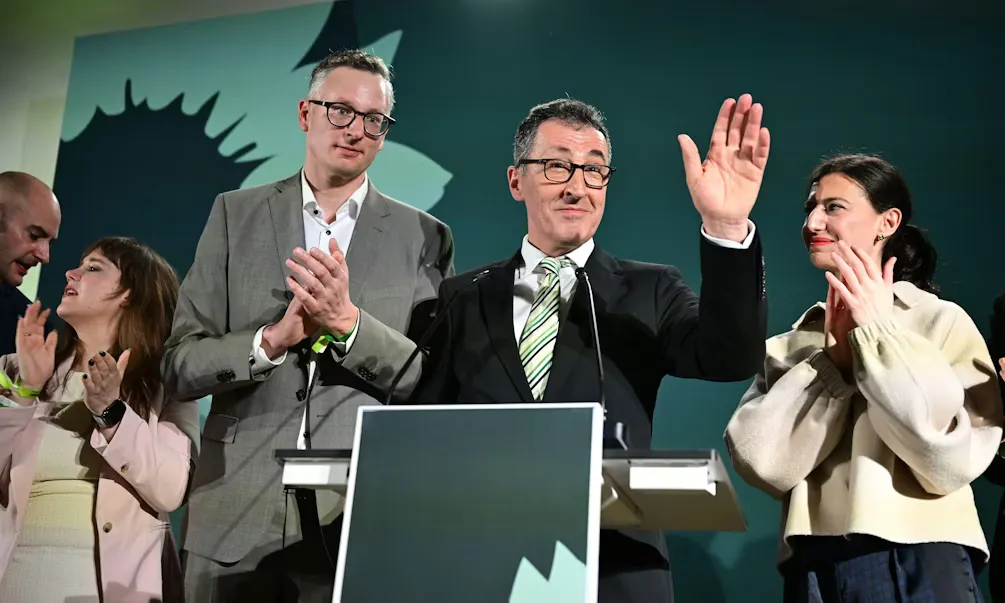
In the 2026 election, Cem Özdemir replicated this strategy with notable skill. Well known to the German public from his long career in federal politics, he explicitly distanced his campaign from his Green party controversies and positioned himself as a pro-industry, pragmatic leader. In his campaigning he addressed economic issues, promised restrictive immigration policies alongside green industrial transformation and aligned himself with Kraschmann legacy and stated that he would follow Kraschmann way of governance (Deborah 2026). His 30.2% result achieved in an election where the main topic was the economy and immigration and where the AFD was mounting its strongest regional challenge suggest that the personal brand of Green leadership in Baden-Württemberg has become semi autonomous from the national party’s image.
Conclusion
The persistence of Green electoral success in Baden-Württemberg despite negative economic growth in the region’s core automotive sector, poses a great challenge to the economic voting model. This paper argues that the Greens victory in elections four times in a row can not be explained by a single theoretical framework, but rather needs a good analysis of the post-materialistic values and personalisation of politics by candidates. The rise of AFD’s voting share from 9% to 18.8% in 2026 elections partially proves economic voting theory demonstrating that some voters who are affected directly by economic slowdown and blame green industry transition for it, punished incumbent governments and voted for AFD. However this theory fails to account for the plurality of voters who despite economic slowdown still voted for the Green party.
To explain this, post-materialism and issue voting theory were used and it was revealed by the Stuttgart 21 project and Fukushima nuclear catastrophe that still there are electorate in whom environmental and quality life concerns have become their political identities. These identities did not disappear even after the economy worsened. But still post-materialist and voting theory are not sufficient to explain the case fully.
The case was examined by personalisation of politics too, embodied first with Kreschmann and subsequently by Cem Özdemir. Both leaders had a pragmatic, pro-industry, non-ideological style of governance that neutralized the traditional economic critique used against the Greens. Özdemir’s 30.2% result in 2026 achieved while distancing himself from the party controversies, and aligning himself with Kreschmann legacy confirms that the Green Brand in Baden-Württemberg has become semi-autonomous from the federal party.
Whether the Greens can continue to win elections in Baden-Württemberg as the costs of decarbonization deepen is an open question. What the 2026 election makes clear is that green parties can sustain electoral coalitions in industrial heartlands not by abandoning environmental commitments, but by embedding those commitments within a pragmatic, pro-industry governing identity.
Sources:
Andreas B. and Nicolas M(11 January 2026). As China sales slow, Germany’s carmakers look to India. DW.
++https://www.dw.com/en/how-german-cars-became-famous-and-how-they-fell-behind/a-75206421++
Frings, N.L., Helm, J.F. & Hahnel, U.J.J. The energy crisis differentially impacted Swiss and German citizens’ energy literacy and efficiency preferences but not their support for climate policies. Commun Earth Environ 5, 544 (2024). ++https://doi.org/10.1038/s43247-024-01719-7++
Deborah C. (9 March 2026). “Bitter result for Friedrich Merz as Greens win in German car heartland. TheGuardian.
Frieske, B., Hasselwander, S., Deniz, Ö., Stieler, S., & Schumich, S. (2024). Scenario-Based Analysis of Electrification Effects on Value Creation and Employment Structures for the Automotive Industry in the Federal State of Baden-Wuerttemberg, Germany. World Electric Vehicle Journal, 15(10), 480. ++https://doi.org/10.3390/wevj15100480++
Olaf E. and Eric N.(1 February 2011). The evolution of German industrial legends: the case of Baden-Württemberg, 1940–2007. Business History 53(1),144–168.
++https://ssl.lu.usi.ch/entityws/Allegati/pdf_pub5396.pdf++
Ministerium für Wirtschaft, Arbeit und Tourismus Baden-Württemberg(2024). Economic Facts and Figures Baden-Württemberg 2024.
Keil, S., & Gabriel, O. (2012). The Baden-Württemberg State Election of 2011: A Political Landslide. German Politics, 21(2), 239–246. ++https://doi.org/10.1080/09644008.2012.677033++
Blumenberg, J. N., & Blumenberg, M. S. (2018). The Kretschmann Effect: Personalisation and the March 2016 Länder Elections. German Politics, 27(3), 359–379. ++https://doi.org/10.1080/09644008.2017.1342814++
Drewes, O. (14 March 2021). Parliamentary Election in Baden-Württemberg. BLUE, 1(1), 38–44. ++https://doi.org/10.3917/blue.001.0040++.
Landtag Baden-Württemberg. (2011). Landtagswahl 2011.
++https://www.landtag-bw.de/de/der-landtag/parlament/fruehere-landtagswahlen/landtagswahl-2011++
Landtag Baden-Württemberg. (2016). Landtagswahl 2016.
++https://www.landtag-bw.de/de/der-landtag/parlament/fruehere-landtagswahlen/landtagswahl-2016++
Staatsministerium Baden-Württemberg. (1 April 2021). Amtliches Endergebnis der Landtagswahl 2021.
Hörisch, F., Wurster, S.(8 August 2019). The Policies of the First Green-Red Government in the German Federal State of Baden-Württemberg, 2011–2016. Polit Vierteljahresschr 60, 513–538 (2019). ++https://doi.org/10.1007/s11615-019-00170-0++
Land, E. (3 May 2013). An analysis of factors affecting the Green Party’s success in German politics (Departmental Honors thesis, Texas Christian University). Texas Christian University Repository.
++https://repository.tcu.edu/server/api/core/bitstreams/01ac5904-d1e1-4adc-bba4-ce387ddf0991/content++
Dalla M. (2025, August 7). The China shock hits Germany. CEPR VoxEU.
++https://cepr.org/voxeu/columns/china-shock-hits-germany?utm_source++
You may also like
Fransa Protestoları:Kemer Sıkma Politikalarının Anlık ve Doğal Bir Sonucu mu Yoksa Küresel Sistematik Kırılmanın bir Göstergesi mi?
Fransa’da yaşanan bu süreç tek bir ülkenin iç meselesi olmaktan çıkmış,küresel sistemdeki derin çatlakları su yüzüne çıkarmıştır.
Read Article →Carbonari: Gizli Bir Teşkilatın Sınırları Aşan Hikayesi
Fransa’nın başına geçen İtalyan subay Napolyon’un yeğenleri Louis Napoleon ve Napoléon-Louis Bonaparte dahi Carbonaro idi.
Read Article →Konrad Adenauer: Almanya’yı Yeniden Ayağa Kaldıran Siyasetçi
Adenauer, Nazi yönetimine karşı duruşuyla siyasi sürgüne itildikten sonra savaş sonrası Almanya’nın ilk şansölyesi oldu.
Read Article →