Research Visit: Embassy of Latvia in Türkiye
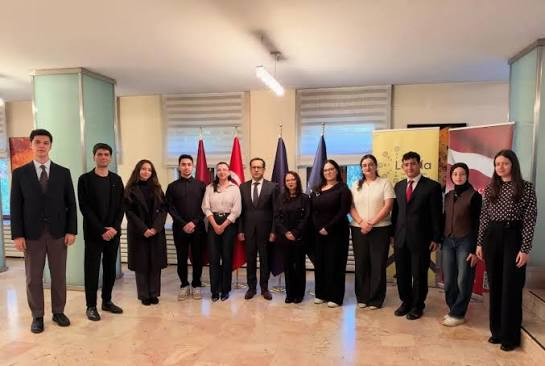
On October 20, 2026, the Global Policy Community visited the Embassy of Latvia in Türkiye. The embassy hosted us warmly, and Ambassador Bahtijors Hasans spoke about informative and valuable topics, including a digitalized and green Latvia and its relations with Türkiye.
The Ambassador’s Background
Ambassador Hasans began by describing his career. He came to Türkiye as ambassador two years ago, and before that he served as ambassador in Geneva. He studied at the Vienna Diplomatic Academy, graduated from law school, and now works for the Latvian Foreign Service.
Latvia at a Glance and Digitalization
The Ambassador then introduced Latvia. Riga is its capital, and he described the country as a Northern European state that is very green and has some of the cleanest air in the region. The average monthly salary is €1,685, and unemployment is only 6.9 percent. Latvia also has access to the EU market of 450 million consumers.
He went on to digitalization, an area where Latvia shares first place with Estonia. Its public services are 91 percent online. When we asked why the country puts so much effort into digitalization, he explained that Latvia has only 1.9 million people and does not have enough staff to provide every service face to face.
The Ambassador also stressed that digitalization fights corruption. He said: “If you do something wrong, you pay for it with no exception.” In his view, when systems are digitalized, especially in health and official transactions, corruption decreases and border control becomes easier. Latvia mastered digitalization on purpose for these reasons, and for the same reasons remote services are a priority.
Defence and Investment
Latvia is a member of the European Union and NATO, so the conversation moved to defence. Mr. Hasans said Latvia spends 3.5 percent of its GDP on defence. In other words, for every €100 the economy produces, €3.50 goes directly into the defence budget.
We also learned that Latvia is one of the fastest-growing destinations for foreign direct investment (FDI) in Europe. Its green economy, stable currency and stable economy mean that investments pay back to investors. As an added benefit, a person who invests in Latvia pays no taxes as long as the money stays in the Latvian economy. Because Latvia is so digitalized, investments can also be managed 100 percent remotely.
Education
We were especially curious about education, and the Ambassador explained it very well. Latvia has strong, long-established universities. Around 1,200 Turkish students study there, mostly medicine and engineering. Latvia also excels in quantum physics: it has the Latvian Quantum Initiative, where researchers are developing quantum algorithms.
Latvian schools teach both English and German. Students begin English classes in third grade, and German lessons are added in sixth grade.
Future-Ready Industries, Companies and Partnerships
The conversation then turned to future industries. According to the presentation prepared by the embassy staff, Latvia focuses on these future-ready sectors: Build for Scale, Driven by Innovation, Defence, Bioeconomy, Life Sciences, Manufacturing and Engineering, Smart Energy, and Digital Technologies.
The remark we appreciated most came next: Latvia’s products should be niche, high-tech and expensive, not basic commodities. The Ambassador also spoke about nanotechnology, saying, “It changes everything,” and turned to renewable energy. He added with a smile that solar power is not a big solution for Latvia because, obviously, the country has little sun. That made us all laugh.
He then named some famous Latvian companies that global innovators trust: Aerones, Norse, GoCardless, Baltic Photonics and Frankenburg Technologies. He also said Latvia has supplied 12,000 drones to Ukraine and cooperates with the Turkish companies Aselsan, Roketsan and Asiltürk. Latvia, he added proudly, is the number one producer of space technologies and optical cables.
Finally, he noted that when goods are sent to other countries, diplomacy and bureaucracy are necessary.
Questions and Answers
We then asked our questions.
Advice for students. The Ambassador recommended that we look for master’s programmes in the Middle East or Africa. Since both countries are OECD and NATO members, he said, we should pursue this. His number one priority is attracting young students to Latvian universities.
Renewable energy. Latvia has neither nuclear energy nor coal, and it imports gas from Norway. However, it has forests, because it is a green country, and its wind power is in quite good shape.
Digitalization and cyber security. We asked how many types of digitalization Latvia has and whether, being so digitalized, it faces cyber attacks. The Ambassador said there are different kinds of digitalization. In an emergency, people do not have to visit offices in person, and their data is protected. Because the population is small, Latvia is keen on personalized and protected information. He added, “You must set clear rules in order to stop corruption,” and said Latvia promotes human rights.
On cyber attacks, he said Latvia has cyber protection organizations and described such attacks as part of hybrid war. Only some small companies suffer from them. In his words, “When you have a strong wall and control, they can’t get in easily.”
Closing
As mentioned at the beginning, the Latvian Embassy hosted us warmly. They offered tea, excellent coffee and special chocolates from Latvia. As the Global Policy Community, we are pleased to have been hosted and to have gained so much valuable information, and we would love to stay in contact with the embassy.
Prepared By: Elif Eylül Bulut
Europe Researcher and Coordinator, Regional Research Unit